
Formula Student
The competition
The world's largest design competition for students: build, present, drive - and win as a team.
Formula Student is the world's largest engineering design competition for students. Every year, students develop, design, and manufacture a race car and compete with it at various events against other universities.
The first Formula Student competition took place in 1981 in Michigan, USA. In 1998, the first European competition was held. Today, many events are organized all over the world. Formula Student Germany, held at Hockenheimring since 2006, has developed into the most important event of this kind.
To win, you need more than speed. Non-technical skills and knowledge about race car development are equally important - from Business Plan Presentation and Engineering Design to the Cost & Manufacturing Report.
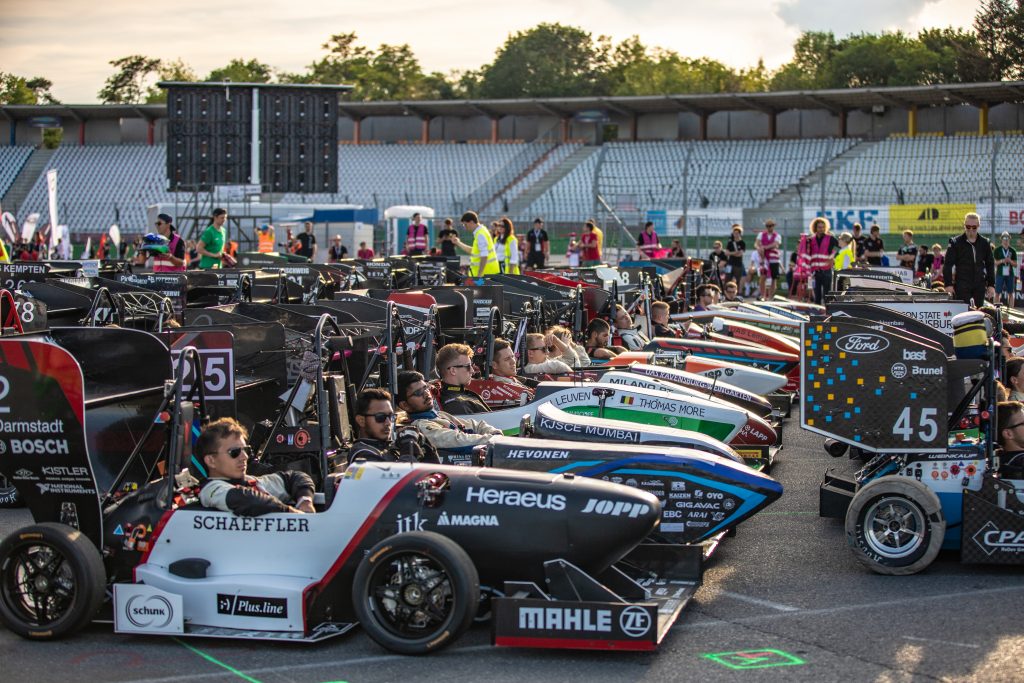
Formula Student originally started primarily with combustion engines. Accordingly, the oldest class is Formula Student Combustion (FSC). This class still exists today, even though its relevance is gradually declining. Driven by innovation, another class was added in 2010: Formula Student Electric (FSE). In this class, teams must develop a fully electric powertrain. The only limits are defined by the rules, including, for example, a 600V limit and the use of an accumulator (no fuel cells). The accumulator type itself is not restricted, making Formula Student Electric one of the most diverse electric racing series.
Formula Student Germany was the first Formula Student competition to decide that from 2024 onward only electric race cars will be invited, with a growing focus on autonomous driving.
Formula Student Driverless (FSD) was added in 2017 - again driven by innovation. In this class, the race car drives fully autonomously.
Technical Inspection - Scrutineering
To participate in the driving disciplines, the built race car must pass technical inspection, called scrutineering. For electric vehicles like ours, this includes:
Electrical Scrutineering
Because of the high voltages and power levels at which the vehicles operate, they must include appropriate safety mechanisms. Examples include insulation monitoring and emergency shutdown if the accumulator leaves its safe operating range.
Tech and Safety
The race car must be safe. This includes, for example, steering safety, frame structure safety, and more. In addition, the driver must be able to exit the vehicle within 5 seconds.
Tilt Table
In the tilt table test, the vehicle is tilted to 45°. No liquids may leak and no components may detach. At up to 60°, the upper wheels must still remain in contact with the rotating surface.
Rain Test
For electric vehicles, it is also verified whether the race car is sufficiently protected against rain and properly insulated. This is a critical safety factor, especially for electric cars.
Brake Test
The brake test verifies that the vehicle can lock all four wheels simultaneously to bring the car to a fast, straight stop.
Dynamics
Endurance
Efficiency
Autocross
Acceleration
In addition, this discipline is also run in the Driverless class, where up to 75 additional points can be achieved.
Skid Pad
Additionally, the car also completes the course autonomously in the Driverless discipline, where up to 75 extra points can be earned.